About Services Training Insights

Insights · The Workplace Inclusion Consultancy

Knowledge that drives inclusion.

Practical guides, policy updates, research-backed insight, and our weekly newsletter - everything you need to build a more inclusive workplace.

Join us live.

Free online sessions on workplace inclusion - practical, expert-led, and open to anyone working in HR, people management, or DE&I. Register your place below.

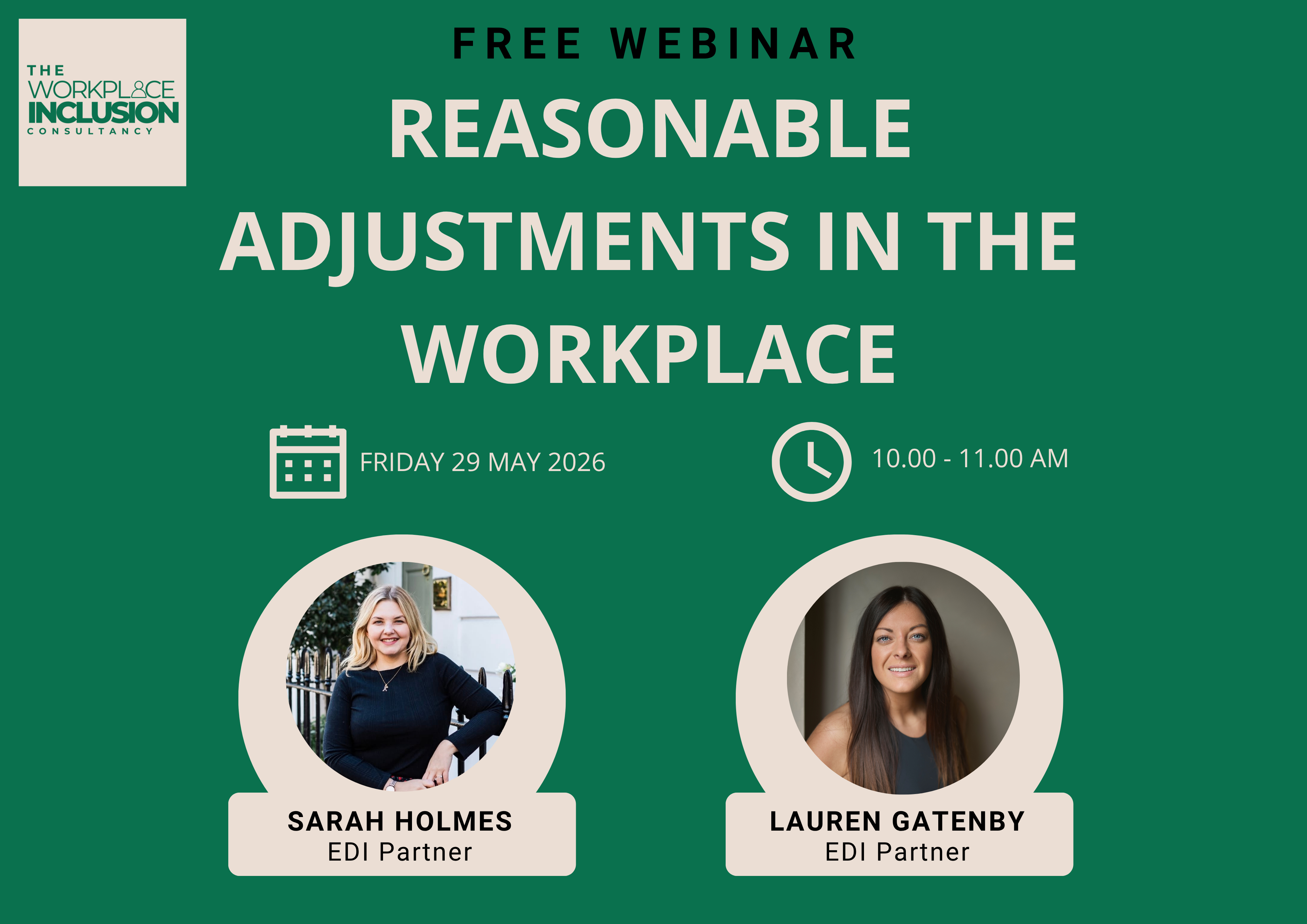
Reasonable Adjustments in the Workplace - Free Webinar, Friday 29 May 2026, hosted by TWIC
Upcoming Fri 29 May 2026 · 10:00am – 11:00am BST Free

Reasonable Adjustments in the Workplace

Most managers want to get reasonable adjustments right - they just aren't sure how. In one practical session we cover the legal framework, who's covered, what "reasonable" really means in practice, the risks of getting it wrong, and a practical approach you can use on Monday morning.

Sarah Holmes & Lauren Gatenby, Co-Founders · Online · Free

More sessions coming soon

Enter your email to be notified when new webinars are announced.

Find what you need.

Every article is tagged by topic. Use the filters below to go straight to the guidance most relevant to you.

Compliance 8 min read

The Worker Protection Act 2023: What Every UK Employer Must Do Now

From October 2024, UK employers have a new legal duty to take reasonable steps to prevent sexual harassment in the workplace. This isn't a best-practice recommendation - it's enforceable by the EHRC and can result in a 25% uplift on discrimination awards at Employment Tribunal. We break down exactly what the duty requires, what 'reasonable steps' means in practice, and how to evidence compliance.

Compliance 5 min read

Gender Pay Gap Reporting 2025: Are You Ready?

The 5 April snapshot date has passed, meaning organisations with 250 or more employees in Great Britain are now preparing their 2025 gender pay gap reports. Deadlines are 30 March for public sector employers and 4 April for private and voluntary sector organisations - and the data alone won't tell your story. This guide covers the six required metrics, how to calculate mean and median pay gaps accurately (including bonus pay and quartiles), and why the accompanying narrative report matters more than most HR teams realise. We also flag the most common methodology errors that lead to inflated gaps, and how to frame a genuine action plan that the EHRC - and your workforce - will find credible.

Management 6 min read

One Conversation That Changes Everything: The Reasonable Adjustment Conversation

Most managers know they're legally required to make reasonable adjustments for disabled employees under the Equality Act 2010 - but far fewer feel confident having the conversation that makes those adjustments happen. The result is a gap between legal obligation and lived experience: employees who don't ask because they fear being seen as a burden, and managers who don't offer because they're afraid of getting it wrong. This guide gives you the language, the structure, and the mindset to open that conversation well. We cover what to say when you notice someone is struggling, how to respond when an employee discloses a condition, how to explore what would genuinely help, and what to absolutely avoid - including the common but well-meaning mistakes that can make people feel surveilled rather than supported.

Recruitment 5 min read

Five Things Your Job Adverts Are Accidentally Doing to Exclude Disabled Candidates

Research consistently shows that disabled people self-select out of job applications long before they reach an interview - and your job advert is often the first barrier they encounter. The problems are rarely intentional, but they're pervasive: vague 'essential' requirements that are actually preferences, inaccessible application formats, language that codes for a particular kind of worker, and missing information about adjustments available. Under the Equality Act 2010, employers must not place disabled applicants at a substantial disadvantage, and that duty arguably begins the moment a job is advertised. This article walks through five of the most common advert-level exclusions, with before-and-after examples and practical rewrites you can use immediately to make your next role genuinely open to all.

Wellbeing 7 min read

Menopause at Work: What UK Law Now Requires and What Good Practice Looks Like

Menopause is not a protected characteristic in its own right under the Equality Act 2010, but that doesn't mean employers are off the hook. Employment Tribunals have upheld claims of sex discrimination, age discrimination, and disability discrimination in cases where menopausal symptoms - which can include severe cognitive difficulties, anxiety, and physical pain - were not properly accommodated. The EHRC's updated guidance makes clear that where symptoms amount to a disability, the duty to make reasonable adjustments applies in full. This article explains the legal framework, the most common workplace adjustments that make a material difference (temperature control, flexible hours, access to welfare facilities), how to write or update a menopause policy that's more than a tick-box exercise, and why manager training is the single highest-impact lever most organisations haven't pulled yet.

Newsletter 3 min read

This Week: Flexible Working Changes, Neurodiversity Awareness Month, and Our New Course

This week's edition covers what the Flexible Working Regulations 2024 mean in practice now that the initial response window has been tested across real organisations - including the most common grounds employers are using to refuse requests and whether those refusals are holding up. We also look at Neurodiversity Celebration Week: what it actually means for HR beyond awareness posts, how to make your reasonable adjustments process neuroinclusive by design, and the research on why neurodivergent employees are disproportionately exiting organisations within the first two years. Plus: our new online course on Inclusive Recruitment goes live this month - we share what's in it and who it's built for.

Management 6 min read

Why Your Performance Management Process Might Be Discriminatory (And What to Do About It)

Performance management processes are one of the most legally exposed areas in employment - and one of the least scrutinised for bias. If your organisation uses rating distributions or forced-curve systems, applies a single performance standard without considering reasonable adjustments, or relies on manager discretion during calibration without structured criteria, you are likely producing outcomes that are systematically unfair to disabled employees, women returning from parental leave, and people from marginalised ethnic backgrounds. Research by the CIPD and others consistently shows rating gaps that cannot be explained by output alone. This article sets out how to audit your current process, what structural changes reduce discriminatory outcomes, how calibration sessions should be run with inclusion embedded from the start, and what your Employment Tribunal exposure looks like if a performance decision is challenged.

Compliance 4 min read

The Flexible Working Regulations 2024: Day-One Rights and What's Changed

From 6 April 2024, employees have the right to request flexible working from their first day of employment - no more 26-week qualifying period. Employers now have two months (not three) to deal with a request, must consult with the employee before refusing, and employees can make two requests in any 12-month period rather than one. The eight statutory grounds for refusal remain unchanged, but the removal of the requirement to explain how the request affects the business has been dropped: employers must now give reasons in writing when refusing. This article breaks down each change, what your flexible working policy needs to be updated to reflect, and the practical questions HR teams are asking - including how to handle simultaneous requests, what 'consult' actually requires, and whether you can still have blanket office attendance requirements.

Recruitment 5 min read

Structured Interviews: The Inclusion Upgrade Your Hiring Process Needs

Unstructured interviews are one of the weakest predictors of job performance and one of the strongest drivers of in-group bias - yet they remain the most common hiring method used by UK employers. A structured interview, where every candidate is asked the same competency-based questions in the same order and assessed against the same pre-agreed scoring rubric, reduces the influence of personal rapport, accent, appearance, and shared background on hiring decisions. The evidence is robust: structured interviews have roughly twice the predictive validity of unstructured ones. This article explains how to design structured interview questions that map to genuine role requirements, how to build and use a scoring rubric that gives assessors useful anchors rather than vague descriptors, how to brief panel members, and how to handle reasonable adjustments within the interview process itself - including what to offer and when.

Work with us

Ready to go beyond the reading?

We work with UK businesses to embed inclusion in practice, not just policy. Book a free 30-minute call to talk through where you are and what you need.